Thursday, October 11, 2018

words of Buddha


No automatic alt text available.དེ་ནས་བཅོམ་ལྡན་འདས་ཀྱིས་བཀའ་སྩལ་པ་འདི་ལྟ་བུའི་ཆོས་ཞུས་པ་ལེགས་སོ། །ལེགས་པར་ཉོན་ཅིག་དང༌། ངས་བཤད་པར་བྱའོ། །ང་མྱ་ངན་ལས་འདས་ནས་དམ་པའི་ཆོས་ཀྱི་གཟུགས་བརྙན་ལོ་ཉིས་སྟོང་དུ་གནས་པར་འགྱུར་རོ།
Then the Bhagavān gave teaching thus: “It is excellent that you request a Dharma such as this. Listen well; and I shall explain it. After I pass into Nirvāṇa, the reflection of the Transcendent Dharma will remain for two thousand years.”

།བྱང་ཆུབ་སེམས་དཔའ་ཟླ་བའི་སྙིང་པོས་གསོལ་པ། བཅོམ་ལྡན་འདས། དམ་པའི་ཆོས་འདི་ཐ་མར་ཇི་ལྟར་ནུབ་པར་འགྱུར། རྒྱུ་ཅི་ལས་ཉམས། སུས་མ་མཆིས་པར་བགྱིད།
The Bodhisattva Candragarbha spoke thus: “Bhagavān, how will the Transcendent Dharma, in the end, come to wane? Through which causes will it degenerate? By whose actions will it come to naught?”

བཀའ་སྩལ་པ། ང་མྱ་ངན་ལས་འདས་པའི་འོག་ཏུ་ལོ་ལྔ་བརྒྱའི་བར་དུ་ངའི་བསྟན་པ་ལ་སྤྱོད་པའི་སེམས་ཅན་རྣམ་པར་གྲོལ་བ་མང་དུ་འགྱུར་རོ༑ ༑དེ་ནས་ལོ་ལྔ་བརྒྱའི་བར་དུ་ཏིང་ངེ་འཛིན་ལ་སྤྱོད་པ་མང་དུ་འགྱུར་རོ། །རྒྱལ་པོ་དང༌། བློན་པོ་དང༌། སེམས་ཅན་ཕལ་རྣམས་ཀྱང་དམ་པའི་ཆོས་ལ་དད་ཅིང་སྤྱོད་པའང་ཕྱིར་ཞིང་ཉུང་བར་འགྱུར་རོ།
He gave teaching thus: “After I pass into Nirvāṇa, for five hundred years(1), there will be many sentient beings that practice my teaching who will become completely liberated. Then, for [the next] five hundred years(2), there will be many who practice meditative absorption (samādhi). The kings, officials, and ordinary sentient beings too who have faith and practice the Transcendent Dharma will also, in return, become fewer.”

།དེ་ནས་ལོ་ལྔ་བརྒྱའི་བར་དུ་དམ་པའི་ཆོས་སྟོན་ཅིང་སེམས་ཅན་འདྲེན་པ་དང༌། ཐར་བར་བྱེད་པའི་སློབ་དཔོན་མང་དུ་འབྱུང་ངོ༌། །ཉན་ཐོས་དགྲ་བཅོམ་པ་ནི་ཉུང་བར་འགྱུར་རོ། །རྒྱལ་པོ་དང༌། བློན་པོ་དང༌། སེམས་ཅན་ཕལ་རྣམས་ཀྱང་ཉན་པ་ཙམ་དུ་ཟད་དེ། ཉམས་སུ་ལེན་ཅིང་སྤྱོད་པའམ། བརྩོན་འགྲུས་ནི་མི་བྱེད་དེ། དད་པ་འབྲི་བར་འགྱུར་རོ། །དམ་པའི་ཆོས་ཀྱི་སྲུངས་མ་རྣམས་ཀྱང་མི་དགའ་བར་འགྱུར་ཏེ། དམ་པའི་ཆོས་ལ་མ་དད་པའི་སེམས་ཅན་རྣམས་ནི་སྔོན་པས་མཐུ་སྟོབས་སྐྱེ་བར་འགྱུར་རོ། །འཛམ་བུའི་གླིང་གི་མིའི་རྒྱལ་པོ་རྣམས་ཀྱང་ཕན་ཚུན་གཅིག་ལ་གཅིག་དམག་འདྲེན་ཅིང་འཁྲུག་པར་འགྱུར་རོ། །བདུད་ཀྱི་རིས་ཀྱང་འཕེལ་བར་འགྱུར་རོ།
Then, for [the next] five hundred years(3), there will arise many masters who will teach the Transcendent Dharma, guide sentient beings, and bring them to liberation. Śrāvaka Arhats will become fewer. Kings, officials and ordinary beings too will do no more than what amounts to mere study [or simply listening to the teachings], and will not engage in experiential training, practice, or diligence; hence, their faith will decrease. They will not take joy in the protectors of the Transcendent Dharma, either; and thereby, the sentient beings who do not have faith in the Transcendent Dharma will give rise to greater power and strength than before. The kings of the world will also order their armies against each other, and do battle. The sides of the Māras will flourish, as well.”

1. Although the dates of the Buddha's death are highly disputed, due to various accounts and chronologies, the current consensus places his death and Parinirvāṇa ('final nirvāṇa') sometime between circa 410 BC and 368 BC, within a roughly 42-year time frame. Many more traditional accounts place it much earlier, but this seems unlikely, due to poor historical records of the time, and much evidence to the contrary. Thus the first 500-year period would be approximately 410 BC to 90 AD at the earliest, and 368 BC to 132 AD at the latest.

2. The second 500-year period would be approximately 90 AD to 590 AD at the earliest, and 132 AD to 632 AD at the latest.

3. The third 500-year period would be approximately 590 AD to 1090 AD at the earliest, and 632 AD to 1132 AD at the latest.

-- །།འཕགས་པ་ཟླ་བའི་སྙིང་པོས་ཞུས་པའི་མདོ་ལས།
སངས་རྒྱས་ཀྱི་བསྟན་པ་གནས་པ་དང༌། འཇིག་པའི་ཚུལ་ལུང་བསྟན་པ།
The Prophecy on How the Buddha's Teachings Will Remain and Decline:
From The Sūtra Requested by the Noble Candragarbha

('phags pa zla ba'i snying pos zhus pa'i mdo las/ sangs rgyas kyi bstan pa gnas pa dang/ 'jig pa'i tshul lung bstan pa)

Translated from the Tibetan by Erick Tsiknopoulos


https://buddha-nature.com/


About Black Hayagriva, by Lama Sonam Tsering Rinpoche:

This Extremely Wrathful Black Hayagriva photo comes from the thangka commissioned by Lama Sonam Tsering Rinpoche who worked closely with the artist to ensure the iconography is in accordance with the description in the sadhana.
About Black Hayagriva, by Lama Sonam Tsering Rinpoche:
"The emanation of all Buddha’s speech arises as Avalokiteshvara, the form of compassion. In order to tame the wildest beings, Avalokiteshvara manifests as extremely wrathful Hayagriva. In this time of degeneration the inner elements of beings are imbalanced with very strong clinging and passions. Externally, this causes war and the use of biological and chemical weapons. Many new diseases with no known cure appear and epidemics spread quickly. Even friends, husbands, wives, and children seem intent on cheating and manipulating each other, so that no one knows who to rely on. This naturally leads to imbalances in the outer elements. The water element causes floods, tsunamis, and hurricanes; the fire element causes volcanoes, drought, and heat waves; wind causes tornadoes and windstorms; and the earth element causes earthquakes and landslides. Likewise, all the different classes of spirits become upset. The whole world, whether it is the inner elements of sentient beings or the outer elements, is extremely turbulent and out of control. At times such as this it is difficult for Buddhas, Bodhisattvas and wrathful deities to penetrate beings’ minds. That is when this form of Hayagriva in union with Tröma Nagmo, who is the most wrathful and therefore the most compassionate, appears.
"Extremely Wrathful Black Hayagriva has special power to affect beings’ minds and benefit those who are depressed, dysfunctional, or crazy, as well as to cure disease. This is the condensed essence of all the billions of Hayagriva practices. It is easy to practice and highly effective. Even hearing this practiced will subdue all classes of spirits. Remembering it will eradicate all wrong views and demonic forces. Touching the image of this Hayagriva will pacify all disease and the passions of the five poisons. For whoever has a connection to this practice the seed of samsara will be destroyed.
"Padmasambhava accomplished deathlessness through practicing Hayagriva. He transmitted it to his heart disciples, Yeshe Tshogyal and King Trisong Deutsen to practice and hide as terma. This terma was later discovered by Dudjom Lingpa, who was the emanation of Khyeuchung Lotsawa and Guru Dorje Drolod in person. HH Dudjom Rinpoche compiled this whole practice to make it easy to practice."

Image may contain: 1 person

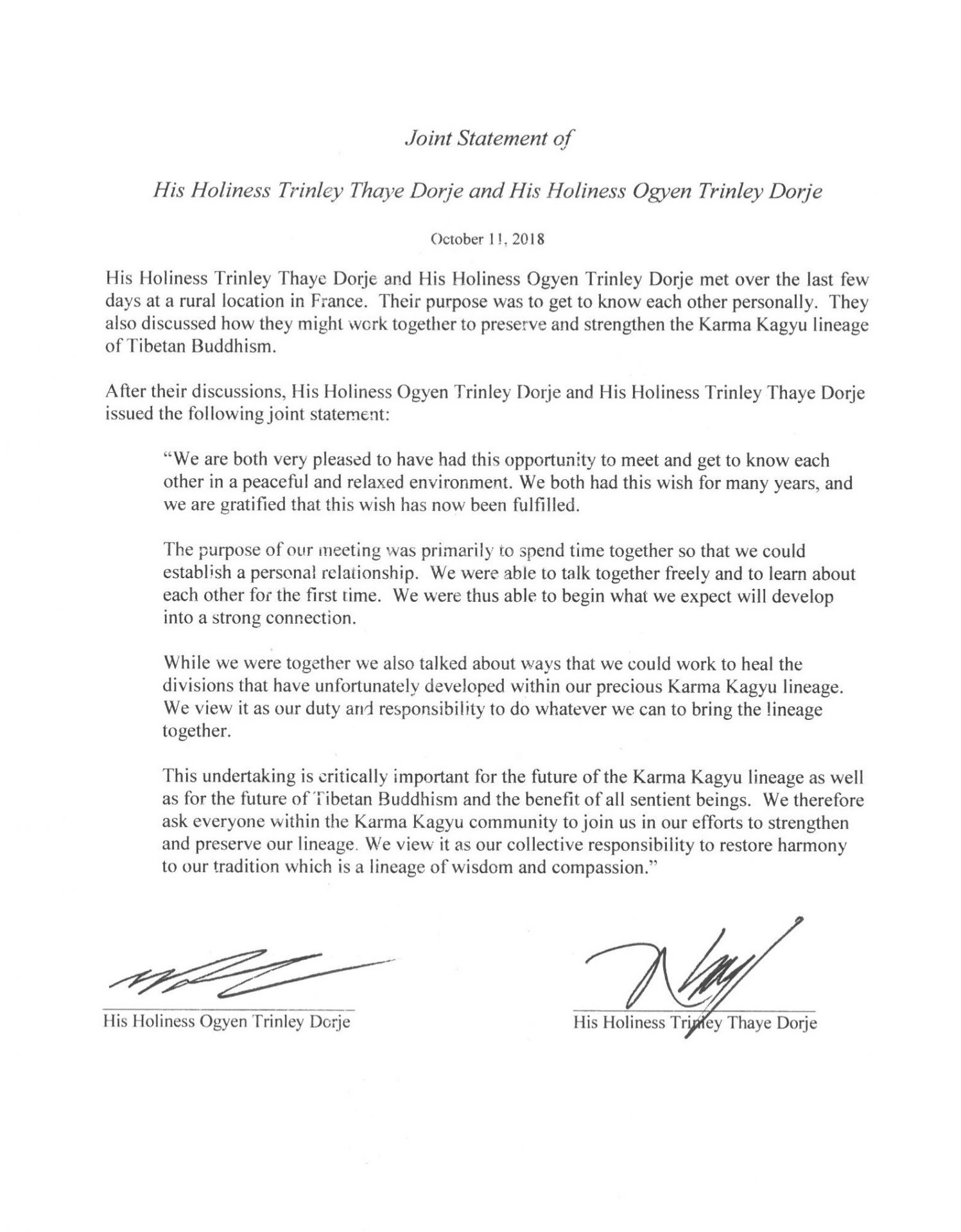
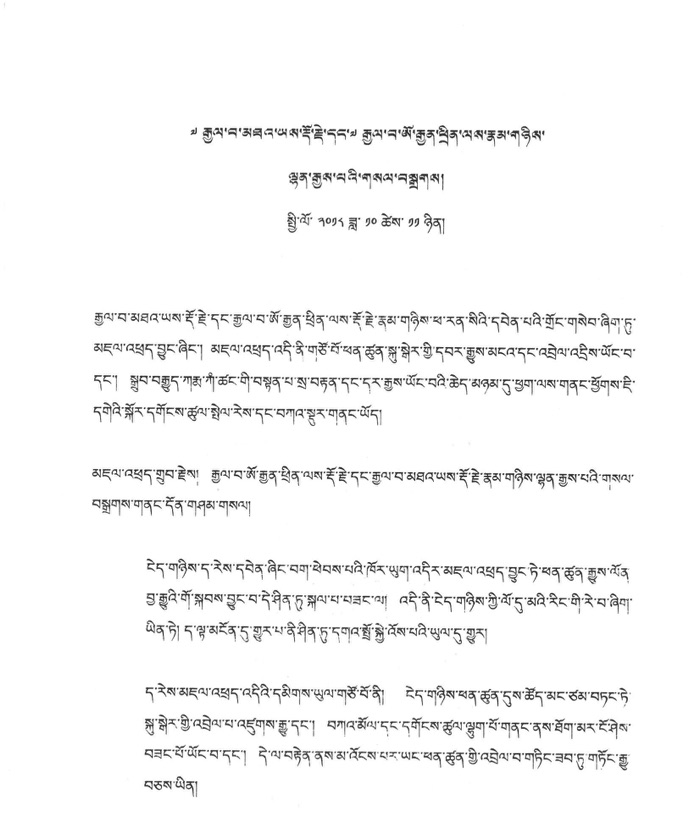
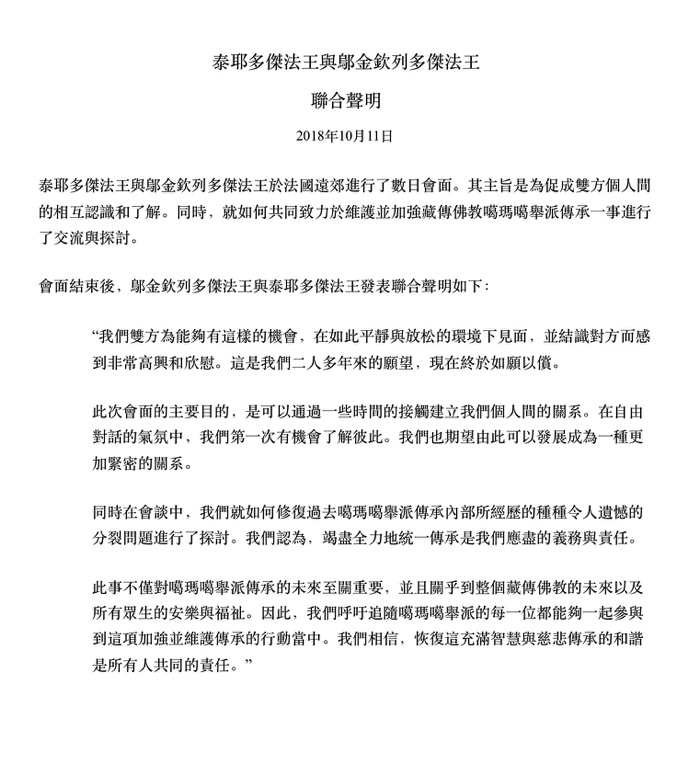
2 Karmapas meet Oct 11 2018

https://www.karmapa.org/joint-statement-of-his-holiness-trinley-thaye-dorje-and-his-holiness-ogyen-trinley-dorje/

Joint statement of His Holiness Trinley Thaye Dorje and His Holiness Ogyen Trinley Dorje

Joint statement of His Holiness Trinley Thaye Dorje and His Holiness Ogyen Trinley Dorje

Joint statement of His Holiness Trinley Thaye Dorje and His Holiness Ogyen Trinley Dorje

Monday, October 8, 2018

Reviving the tantric teachings of Hevajra

Reviving the tantric teachings of Hevajra

Religion: The first tantric institute in the country, which will soon be ready with proper classrooms and hostels, is expected to revive the Hevajra tantra, an advance teaching and practice of understanding the nature of mind.
Started in 2007, the institute, Ngagdra Dorji Choegar still being built at Kurizampa, Mongar, has been sending at least 60 monks a year to nine retreat centres to undergo six practices of Naropa. It offers all major tantric studies of Vajrayana Buddhism.
During the six-year course, monks and lay monks learn mandala making, in-depth study in spiritual instructions, visualization practice, contemplation, receive oral transmission, and learn mantra.
One of the main subjects that are taught throughout the course is Hevajra Tantra, a comprehensive study of Buddhist text taught by the tutelary deity, Hevajra. Hevajra is a male deity that holds personified symbol for the Buddhist concept of a supreme being in the state of nonduality.
Statue of Hevajra being built at the institute
The introduction of this course will help revive the teaching that was on the brink of extinction, said founder of the institute, His Eminence Gyeltshen Trulku.
His Eminence said Hevajra Tantra is an advance teaching and practice of understanding the nature of mind. He added that Zhabdrung Ngawang Namgyal brought the lineage of Hevajra Tantra that was passed down by the great master, Kunkhyen Pema Karpo in Tibet. The teaching had waned after Zhabdrung.
However, the 69th Je Khenpo, late Gendun Rinchen who requested an oral transmission of the teaching from His Holiness Dilgo Khentse Rinpoche wrote a commentary based on the transmission. Since then the teaching was revived.
His Eminence Gyeltshen Trulku said Hevajra Tantra is one of the oldest texts taught before the time of Sakyamuni Buddha. Buddhist canon (kanjur) explains that Hevejra taught Hevejra Tantra on the tip of Mount Meru after subduing lord Shiva.
It is believed that before the existence of Buddha there was no god on the earth to whom people could take refuge. They approached lord Shiva who was day and night uniting with his consort Parvati.
Having no time to attend to peoples’ request, Shiva gave devotees his representative, Shivalinga. In Hindu faith Shivalinga is worshipped even today.
It is also believed that devotees who had tremendous desire indulged in sex, and those who had high level of hatred slaughtered animals, and offered their blood to Shiva. While people with ignorance kept drinking day and night.
Knowing that people were going on the wrong path, the bodhisattvas sent Hevajra to Mount Meru to subdue Shiva. Hevajra took the form of Sihva so that people would not mistake with their lord.
As a mark of victory Shiva was put beneath the feet of Hevajra deity and it is depicted in the statue today. After subduing Shiva the first teaching Hevajra gave was Hevajra Tantra. Gyeltshen Trulku said after that Hevajra converted eight sites of Shiva into eight major crematoriums and 32 villages into pilgrim sites.
As homage to Hevejra, the institute is building a 21-feet tall statue of the deity. It will be the largest statue in the country. The deity has eight faces with 16 arms. He holds his consort, which in Buddhism is union of wisdom and compassion, the essence of ultimate realization.
His Eminence said tantric study would give a complete set of knowledge and skills that one requires in retreat centres. “Once they graduate from the institute they can straight away start with meditation,” he said.
The courses began with the construction of the institute in 2007. Each year at least 60 monks graduate from the institute and join the retreat centres for three and six year-meditation course. There are around 200 monks.
His Holiness the Je Khenpo on October 30 will consecrate the institute.
Tenzin Namgyel

http://www.kuenselonline.com/reviving-the-tantric-teachings-of-hevajra/

Tuesday, October 2, 2018

on Eternalism and Nihilism

What Buddhists BelieveVenerable K. Sri Dhammananda Maha Thera

Eternalism and Nihilism

  The Buddha rejected both extremes of eternalism and nihilism.  
To develop Right View or Perfect View, we must first be aware of two views which are considered imperfect or wrong.
The first view is eternalism. This doctrine or belief is concerned with eternal life or with eternal things. Before the Buddha's time, it was taught that there is an abiding entity which could exist forever, and that man can live the eternal life by preserving the eternal soul in order to be in union with Supreme Being. In Buddhism, this teaching is called sassata ditthi ----the view of eternalists. Such views still exist even in the modern world owing to man's craving for eternity.
Why did the Buddha deny the teaching of eternalism? Because when we understand the things of this world as they truly are, we cannot find anything which is permanent or which exists forever. Things change and continue to do so according to the changing conditions on which they depend. When we analyse things into their elements or into reality, we cannot find any abiding entity, any everlasting thing. This is why the eternalist view is considered wrong or false.
The second false view is nihilism or the view held by the nihilists who claim that there is no life after death. This view belongs to a materialistic philosophy which refuses to accept knowledge of mental conditionality. To subscribe to a philosophy of materialism is to understand life only partially. Nihilism ignores the side of life which is concerned with mental conditionality. If one claims that after the passing away or ceasing of a life, it does not come to be again, the continuity of mental conditions is denied. To understand life, we must consider all conditions, both mental and material. When we understand mental and material conditions, we cannot say that there is no life after death and that there is no further becoming after passing away. This nihilist view of existence is considered false because it is based on incomplete understanding of reality. That is why nihilism was also rejected by the Buddha. The teaching of kamma is enough to prove that the Buddha did not teach annihilation after death; Buddhism accepts 'survival' not in the sense of an eternal soul, but in the sense of a renewed becoming.
Throughout the Buddha's long period of teaching the Dhamma to His followers, He actively discouraged speculative arguments. During the 5th century B.C. India was a veritable hive of intellectual activity where scholars, yogis, philosophers, kings and even ordinary householders were constantly engaged in the philosophical arguments pertaining to human existence. Some of these were either ridiculously trivial or totally irrelevant. Some people wasted valuable time arguing at great length about all manner of subjects. They were far more concerned about proving their powers in mental gymnastics than seeking genuine solutions to the problems that beset humanity. (In the 18th century Jonathan Swift satirized a similar pastime in England when he showed the Lilliputians in 'Gulliver's Travels' waging a war to decide whether an egg should be broken on its sharp end or its broad end).
The Buddha also refused to get involved in speculations regarding the universe. He stated very clearly that the problem facing mankind is not in his past or his future but in the immediate present. Knowledge about Eternalism or Nihilism can in no way help man to break the present fetters which bind him to existence and which are the source of all his feelings of discontent which arise from his inability to completely satisfy his cravings. The Buddha stated that before one can begin to tread the path which leads to Nibbana one must have Right View. Only when one knows clearly what one is seeking will one be able to attain it.
  -ooOoo-


https://www.budsas.org/ebud/whatbudbeliev/111.htm
Trending today: "It may seem contradictory, but Yidam practice, where we visualize ourselves as an enlightened deity, is designed to help us overcome our sense of "ordinariness" and to demonstrate, in a sense, the emptiness of our perceptions.
Zasep Tulku Rinpoche described Yidam practice — in an interview in Buddha Weekly — in context with "emptiness":
"...Every time you do any of these practices, first you meditate on emptiness. You start with the Sanskrit mantra, Om Svabhava Shuddo and so on, “every thing becomes voidness.” Then you visualize your consciousness arising as a seed syllable, then the deity. So, when you do these practices, this “I” — ordinary man or woman ego — is already gone. You transform the I, or ego, by meditating on emptiness. When there is no self, who is there to be angry? Who is there to be terrified?""
https://buddhaweekly.com/the-lightning-path-of-buddhism-th…/

https://buddhaweekly.com/the-lightning-path-of-buddhism-the-power-of-yidams/


If I do not go to hell to help, who will go? Only when all beings have been liberated, will I become Buddha 
~ Kṣitigarbha